As the A to Z Challenge for 2012 approached, I thought for sure that I would never be able to come up with another alphabet about gardening. I struggled to get through last year's challenge, finishing it up in May or so. It is the only alphabet I managed to finish last year. Yet once the deadline for signing up hit, I decided to take it on again.
I did fall behind in April, due to illness and being busy. I also had entered 8 blogs into the challenge. Crazy, I know. But I did manage to finish all 26 posts in time for the deadline at 11:59 p.m. on April 30th.
I had fun trying to think up different flowers and plants again. I believe I have exhausted most opportunities for some of those tricky letters, though. I doubt I will do it again next year, at least for this blog.
In addition to inspiring me to start writing about gardening again, this challenge inspired me to whip my yard back into shape again, as well. I look forward to sharing that progress with you over the next several months.
Here is a list of this year's A to Z contributions. I am also including last year's alphabet at the end. Thanks for stopping by!
A is for Azaleas
B is for Beans
C is for Coleus
D is for Dogwood
E is for Echinacea
F is for Forsythia
G is for Gardenia
H is for Hostas
I is for Ivy
J is for Johnny Jump-Ups
K is for Killing Everything
L is for Lilies
M is for Mums
N is for Nasturtium
O is for Orchid
P is for Peony
Q is for Queen Anne's Lace
R is for Rhododendron
S is for Sunflower
T is for Tickseed
U is for Umbel
V is for Vinca
W is for Wonder
X is for Xanthospermous
Y is for Yard
Z is for Zinnia
Here is last year's alphabet:
A is for Annuals
B is for Bulbs
C is for Crocuses
D is for Daffodils, Dahlias and Daisies
E is for Easter Lily
F is for Ferns
G is for Geranium
H is for Hyacinths
I is for Irises
J is for Japanese Maples
K is for Killing Beetles
L is for Lilacs
M is for Mulch
N is for New Ideas
O is for Organic Gardening
P is for Perennials
Q is for Quarreling
R is for Roses
S is for Snapdragons
T is for Tulips
U is for Upside-Down Tomatoes
V is for Violets
W is for Wisteria
X is for Xeranthemum
Y is for Yarrow
Z is for Zazzle
Showing posts with label A to Z Challenge 2012. Show all posts
Showing posts with label A to Z Challenge 2012. Show all posts
Sunday, May 13, 2012

Monday, April 30, 2012
Gardening A to Z: Z is for Zinnia
For some reason, when I was a kid, I often got zinnias and marigolds confused. I guess that isn't too abnormal, as some varieties of zinnias do resemble marigolds.


I just didn't really care for them, though. My father adored them and planted them in front of the store every year. Perhaps if I caught more glimpses of butterflies on them like in the picture, I wouldn't mind as much.
A few years ago, I was shopping for seeds when I realized that zinnias had even more shapes. I am particularly drawn to the pinwheel ones.
Now that I know there are more varieties and colors, I tend to include them every year. I put them in a bed that has small peonies growing. I plant a mix of seeds of zinnias, sunflowers, cosmos and portulaca, for a variety of height and texture in color. And then I hope the birds don't eat all of the seeds before they get a chance to grow.
I have already purchased my seeds for this year. Now for the weather to get warm enough to start planting them....
Gardening A to Z: Y is for Yard
My yard is my happy place. When I was a kid, I used to spend a lot of time wandering our fenced-in side yard. My dad would talk about how I would wander around his gardens, delicately touching every plant and closely examining them. I loved getting lost among the ferns, trees and bushes. As an adult, I love to sit in my backyard and feel the sun beating down on my face. I love the feeling of release when my fingers dig into the dirt. I love the pride that I feel when I get everything weeded and cut back. I still love to run my fingers through the leaves and to smell each individual bloom. Now I take pictures of what grows, to share them with everyone.
I could sit outside in that small outdoor space all day. The disadvantage of living in a city is that there are always people around. The advantage of my yard, though, is that it is a larger one than most of the people in my neighborhood. I am a single family dwelling on a corner, which leaves me a lot of extra yard space.
Some day I will have to leave this yard behind. And then I will make the next one my happy place.
I could sit outside in that small outdoor space all day. The disadvantage of living in a city is that there are always people around. The advantage of my yard, though, is that it is a larger one than most of the people in my neighborhood. I am a single family dwelling on a corner, which leaves me a lot of extra yard space.
Some day I will have to leave this yard behind. And then I will make the next one my happy place.
Gardening A to Z: W is for Wonder
When I was a child, the garden always filled me with a sense of wonder. I was amazed at how beautiful the plants were. I enjoyed following their cycles through the seasons and was almost able to base time on them. I was amazed at how they seemed to change through the year. I loved the feel of the plants and to smell each one of their scents. I loved to draw pictures of them and used the entire rainbow of that 64-crayon box when coloring in my coloring books. After all, I had a rainbow of flowers available to me every year and they came in more than 8 colors.
As I learned more about plants, I as fascinated with how one little seed could become a big majestic plant. There was a harmony in nature that couldn't be replicated anywhere else. I remember writing my own story about how a seed grows into a flower, and the balance and harmony involved in it. Naturally, I proceeded to lose that story, which is a shame. I remember my teacher telling me to save it and to publish it some day.
I love to share the wonder of plants with my students every year. This year, one of them brought in a starter kit for a sunflower, which accompanies Eric Carle's book The Tiny Seed. We just planted it last week. I also set up my lima bean planting activity. The kids have been busy preparing their seeds in the baggies, so that they can watch how they grow. Every day, they check their plants and are ecstatic when they see signs of growth. I am passing that wonder on to a new generation.
As I learned more about plants, I as fascinated with how one little seed could become a big majestic plant. There was a harmony in nature that couldn't be replicated anywhere else. I remember writing my own story about how a seed grows into a flower, and the balance and harmony involved in it. Naturally, I proceeded to lose that story, which is a shame. I remember my teacher telling me to save it and to publish it some day.
I love to share the wonder of plants with my students every year. This year, one of them brought in a starter kit for a sunflower, which accompanies Eric Carle's book The Tiny Seed. We just planted it last week. I also set up my lima bean planting activity. The kids have been busy preparing their seeds in the baggies, so that they can watch how they grow. Every day, they check their plants and are ecstatic when they see signs of growth. I am passing that wonder on to a new generation.
Gardening A to Z: X is for Xanthospermous
I was looking for words that begin with the letter "x" to fill in this post. Thanks to the Internet, it isn't as difficult as you would think. I found a word on The Phrontistery: "xanthospermous." It means "having yellow seeds." And then it occurred to me that I couldn't think of any plants that have yellow seeds. I had to do more research. I found a lot of information about plants with yellow seeds being dominant. And then there was a bunch of stuff form biology that I vaguely remember from 20 years ago.
Mustard seeds are often yellow or white.
Some varieties of ferns will drop yellow seeds.
A heterozygous pea plants will drop yellow seeds.
Do you know of any other xanthospermous plants?
Mustard seeds are often yellow or white.
Some varieties of ferns will drop yellow seeds.
A heterozygous pea plants will drop yellow seeds.
Do you know of any other xanthospermous plants?
Gardening A to Z: V is for Vinca
Vinca is one of the only groundcovers that I think I would willingly use in one of my gardens. I like the deep green of the leaves. And of course, it has a purple flower. Purple is my favorite color and is automatically used in my garden as any flower that blooms in that color.


Photo copyright Andrea Coventry
Spring time is the best time to see these flowers in bloom. I wish they would last all season. Then again, they are a promise of warmer weather to come, because they arrive in the spring.
Gardening A to Z: U is for Umbel
When doing research for the more difficult letters for this challenge, I came across a great site called Phrontistery. It has a bunch of random words that start with every letter of the alphabet. For the letter "u," I chose "umbel." It means "mass of flowers springing from a single center."
Oh, how I am inspired to go out and spend a wad of money on plants for pots, just from that definition! I have visions of wild color combinations all tightly packed in a burst of petals and foliage and strategically placed all around the garden. One of my favorite places to put a random spray of flowers in a pot is on my old bench in the middle of my side bed. I have an old coal container that someone had in her barn. It is slowly falling apart, so it is useless, except as a gardening ornament. It allows for a burst of color to spring up in the middle of the perennials all season long.
It's too bad that it is still only about 40 degrees outside and that I have no extra cash. Ah, but I can dream....
Oh, how I am inspired to go out and spend a wad of money on plants for pots, just from that definition! I have visions of wild color combinations all tightly packed in a burst of petals and foliage and strategically placed all around the garden. One of my favorite places to put a random spray of flowers in a pot is on my old bench in the middle of my side bed. I have an old coal container that someone had in her barn. It is slowly falling apart, so it is useless, except as a gardening ornament. It allows for a burst of color to spring up in the middle of the perennials all season long.
It's too bad that it is still only about 40 degrees outside and that I have no extra cash. Ah, but I can dream....
Sunday, April 29, 2012
Gardening A to Z: S is for Sunflower
Every year I try to grow sunflowers in my yard. The location is sunny enough. My problem is just that the stupid birds usually feed on the seeds before they have much of a chance to grow. When I first started planting sunflowers in this corner of the yard, I actually would get a few to grow. The birds got smart.


Nevertheless, every year I buy a variety of seeds and plant them in vain, hoping that a few will take. I like to try different varieties in different colors. I am all for tradition, but like to step outside of the box in my yard.
Until mine actually grow, I will continue to drive outside of the city limits to look at the fields of sunflowers in the suburbs. This photo isn't an actual photo of the field to which I am referring, but it gives you the gist. Perhaps this year I will remember to take a picture of it.
Gardening A to Z: R is for Rhododendron
I mentioned azaleas in the first post during the challenge, so I thought it necessary to bring up their cousins, the rhododendrons. I am not sure how I feel about these bushes. The flowers are beautiful and I love the leaves.

What I do not like is that these bushes get so darned big. The azaleas I have in my yard are easy to maintain and to keep small. I have never seen an obnoxiously large azalea bush. One yard in which I do some basic weeding and mulching every year, though, has these ginormous rhododendrons that are as big as the garage. Yes, they provide some great shade and can block the windows. Yes, they are spectacular when they are in bloom. But the rest of the time, they just seem like big blobs of green leaves. I prefer a bit more color and in smaller sizes, I guess.
Gardening A to Z: Q is for Queen Anne's Lace
Queen Anne's Lace is also known as Wild Carrot. Sure enough, if you pull it completely out of the ground, the roots resemble a carrot. You cannot, however, consume them as a human.
Most people consider these plants to be weeds and pull them out as soon as they are spotted in the garden. I happen to find them quite beautiful. Perhaps it is because as a child, they randomly grew throughout the wild areas in our big backyard. They are also fun because you can cut them and place them in a glass of colored water. After a few hours or a day, the white flower on the top will change to whatever color you have dyed the water. It's a great trick to use with young children to demonstrate how water travels from the roots, up the stem, to the flower.

These white weeds resemble the perennial plant yarrow. My father loved to have yarrow in his yard. It made my mom crazy because she always thought it was Queen Anne's Lace and wanted to pull them out. She grew up on a farm and spent many hours having to weed along the tomato plants. I have a tendency to allow them to stay - within reason.
Most people consider these plants to be weeds and pull them out as soon as they are spotted in the garden. I happen to find them quite beautiful. Perhaps it is because as a child, they randomly grew throughout the wild areas in our big backyard. They are also fun because you can cut them and place them in a glass of colored water. After a few hours or a day, the white flower on the top will change to whatever color you have dyed the water. It's a great trick to use with young children to demonstrate how water travels from the roots, up the stem, to the flower.
These white weeds resemble the perennial plant yarrow. My father loved to have yarrow in his yard. It made my mom crazy because she always thought it was Queen Anne's Lace and wanted to pull them out. She grew up on a farm and spent many hours having to weed along the tomato plants. I have a tendency to allow them to stay - within reason.
Gardening A to Z: P is for Peony
Oh, how I love my peonies. These flowers bloom every spring and fill my yard with a wonderful fragrance. They smell the way that I always imagine roses are supposed to smell. Only I have the varieties of roses that rarely give off a fragrance.
I have two colors of peony in my yard. My white one resides in the big side bed and always seems to grow well in advance of the others. This year, it was somewhat damaged by that freak Nor'easter we had last weekend. The heavy snow and ice caused it to bend and some of the stalks broke. There are still several left, but it won't be as big and beautiful as last year.

My other one is a pink variety that grows in the corner that connects my two rosebush rows. It always is slower to come up. I don't know if it is getting too much sun there or is too exposed to the elements, but at least it is finally coming up. I was worried this year that something strange had happened to it. I have it growing on the right side of a mini bed, but there was a peony starting to grow in the middle of the bed. Nothing was happening in the original location. I finally remembered that I planted some new peony roots last year, so the new growth should be those. The original one just started to come up.

I purchased a few other varieties in root form last year and at the beginning of the season this year. I would love to have a bed of peonies that lies behind my lilac bush. They just make me so happy.
[Both photographs in this post are copyright Andrea Coventry.]
I have two colors of peony in my yard. My white one resides in the big side bed and always seems to grow well in advance of the others. This year, it was somewhat damaged by that freak Nor'easter we had last weekend. The heavy snow and ice caused it to bend and some of the stalks broke. There are still several left, but it won't be as big and beautiful as last year.
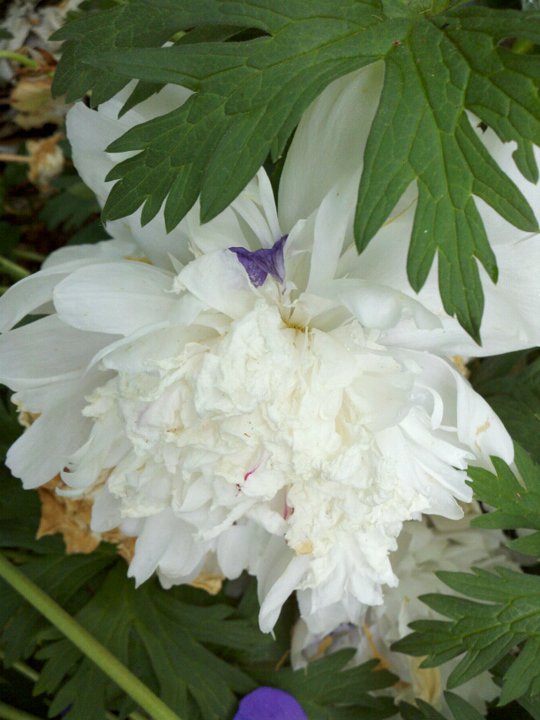
My other one is a pink variety that grows in the corner that connects my two rosebush rows. It always is slower to come up. I don't know if it is getting too much sun there or is too exposed to the elements, but at least it is finally coming up. I was worried this year that something strange had happened to it. I have it growing on the right side of a mini bed, but there was a peony starting to grow in the middle of the bed. Nothing was happening in the original location. I finally remembered that I planted some new peony roots last year, so the new growth should be those. The original one just started to come up.

I purchased a few other varieties in root form last year and at the beginning of the season this year. I would love to have a bed of peonies that lies behind my lilac bush. They just make me so happy.
[Both photographs in this post are copyright Andrea Coventry.]
Gardening A to Z: O is for Orchid
The orchid is a flower that has eluded me through my years of gardening. They are absolutely gorgeous. I see them all the time in the stores. I desperately want to have a purple one growing in my house or in my classroom. But they are just too tempermental for me.

I usually have somewhat of a green thumb, so I thought I would give one a try. I think it lasted maybe a week. I don't think it was attacked by my cat. She pretty much left my plants alone. I think I just didn't understand all that it really took to care for one of these delicate flowers. Some day, when I have more time, I will probably take the time to read up on them more and see if I can try it again.
Gardening A to Z: N is for Nasturtium
Nasturtium is an annual flower that has beautiful orange and yellow blooms on it. You can also use it to garnish your salads. I have never tried it, but I hear it has a somewhat peppery taste, adding a kick to your garden greens.
I usually prefer to use it in pots with other plants in similar colors. As it grows, it can start to hang down from the pot, creating a beautiful trailing feature in your design. Both of my parents really liked them, too.

Have you ever tried it? Or, have you ever eaten any other kinds of flowers? I have only ever had violet jelly.
Wednesday, April 25, 2012
Gardening A to Z: M is for Mums
Back in the day when I tried to have color as long as possible during the season, I used to love mums. I like their intense color blending the garden with the leaves changing colors on the trees. I like how they look in clumps. But they don't stay that way!

I quickly found after a couple of years that they spread quite quickly. What started out as a couple of clumps became a dominant row. It was interesting to see how they started to blend their colors. However, they also prevent bulbs from coming up and are not easy to cut back in the late fall or early spring. Sometimes when I cut out the dead stalks, it leaves an empty hole. Perhaps I am not always doing that part right.
I do keep my mums in my garden. They were in place before I moved in and I have a lot of other plants around them. I am trying to get more to grow up in between them and am trying to contain them. I just don't feel like adding anymore.
Gardening A to Z: L is for Lilies
[All photographs in this post are copyright Andrea Coventry]
I think my lilies are my most prized possession in my yard. I have so many different varieties. I love the way they smell. I love the way they look. There are so many different colors available. They always make me think of summer.
When I was a kid, my dad had tiger lilies growing in the yard, around the plot where our annual wading pool would go. I love the way they fold back and are so speckled.

We also had a lot of daylilies in the yard. I have noticed that most people like to have the traditional yellow ones. I prefer coming up with as many colors and petals as I can.


Asiatic lilies were also an early staple in my gardens. I like the shape of them and am fascinated by their stalks and leaves. Unfortunately, this one kind that those stupid beetles like to eat.

Oriental lilies are similar in appearance to the asiatic lilies, except they are much taller and often have multiple blooms on one stalk. I have Stargazers, which are white and pink, but my white ones are my favorite. They grow as tall as me.

A couple of years ago, I discovered the joys of trumpet lilies. They grow even higher than my Orientals, have a greater blend of color in the blooms, and are the most fragrant that I have found. Again, those stupid beetles are killing them off and it makes me sad. These are not inexpensive plants.

Other kinds of lilies do exist. I have tried Calla lilies, but they require a great deal of care and didn't do well. I hope I can bring all of these back and then add some more later.
I think my lilies are my most prized possession in my yard. I have so many different varieties. I love the way they smell. I love the way they look. There are so many different colors available. They always make me think of summer.
When I was a kid, my dad had tiger lilies growing in the yard, around the plot where our annual wading pool would go. I love the way they fold back and are so speckled.

We also had a lot of daylilies in the yard. I have noticed that most people like to have the traditional yellow ones. I prefer coming up with as many colors and petals as I can.


Asiatic lilies were also an early staple in my gardens. I like the shape of them and am fascinated by their stalks and leaves. Unfortunately, this one kind that those stupid beetles like to eat.

Oriental lilies are similar in appearance to the asiatic lilies, except they are much taller and often have multiple blooms on one stalk. I have Stargazers, which are white and pink, but my white ones are my favorite. They grow as tall as me.

A couple of years ago, I discovered the joys of trumpet lilies. They grow even higher than my Orientals, have a greater blend of color in the blooms, and are the most fragrant that I have found. Again, those stupid beetles are killing them off and it makes me sad. These are not inexpensive plants.

Other kinds of lilies do exist. I have tried Calla lilies, but they require a great deal of care and didn't do well. I hope I can bring all of these back and then add some more later.
Gardening A to Z: K is for Killing Everything
I don't know if it is this wacky spring, or if I really messed things up by not working out in the yard much last year. I just couldn't do it. My heart wasn't in it. And now this spring we have had extremely sunny days followed by snowstorms. It's not good for anything.
Before the Nor'easter hit this past weekend, I spent some time on that sunny Friday (80 degrees) wandering around the yard. I was finally cleaning out a lot of the dead leftovers from last summer, so that you could see the new spring growth. I have noticed that many of my bulbs have not come back. Now, I realize that they do not continue on indefinitely and that the squirrels have a thing for moving them all around the yard. But they are really pathetic and almost nonexistent after a few years of spectacular showings. I also wonder if this hot weather alternating with snow is starting to affect them. They have looked even sadder since.

I also noticed that those damn beetles are already devouring my lilies. I feel sick. They haven't even had a chance to grow and those creatures are just killing them. I have spent so much time and money on growing those lilies and they are just shredded. I am trying to get out at least once a day to pinch them and trying to scrape off the eggs. The one advantage of the snow was they seemed to bury themselves back into the ground.
What is really hurting me right now is it looks like my original Japanese maple is gone. My father bought that for me when I put in my big garden. He loved them and wanted to give me that. It would be ironic for that to go after him, but obviously I am not okay with that. My maples always take a little longer to finally grow their leaves. But when I look at where my other one is in growth and how it has leaves starting to appear, I am not so sure that this one is even budding.
I hope the weather balances itself out soon and that I can keep getting out there to work on it. I want to revive some of this poor yard.
Before the Nor'easter hit this past weekend, I spent some time on that sunny Friday (80 degrees) wandering around the yard. I was finally cleaning out a lot of the dead leftovers from last summer, so that you could see the new spring growth. I have noticed that many of my bulbs have not come back. Now, I realize that they do not continue on indefinitely and that the squirrels have a thing for moving them all around the yard. But they are really pathetic and almost nonexistent after a few years of spectacular showings. I also wonder if this hot weather alternating with snow is starting to affect them. They have looked even sadder since.

I also noticed that those damn beetles are already devouring my lilies. I feel sick. They haven't even had a chance to grow and those creatures are just killing them. I have spent so much time and money on growing those lilies and they are just shredded. I am trying to get out at least once a day to pinch them and trying to scrape off the eggs. The one advantage of the snow was they seemed to bury themselves back into the ground.
What is really hurting me right now is it looks like my original Japanese maple is gone. My father bought that for me when I put in my big garden. He loved them and wanted to give me that. It would be ironic for that to go after him, but obviously I am not okay with that. My maples always take a little longer to finally grow their leaves. But when I look at where my other one is in growth and how it has leaves starting to appear, I am not so sure that this one is even budding.
I hope the weather balances itself out soon and that I can keep getting out there to work on it. I want to revive some of this poor yard.
Sunday, April 15, 2012
Gardening A to Z: J is for Johnny Jump-Ups
You know that spring is coming when the Johnny Jump-Ups start to pop up in the garden! These perennial violas are related to pansies. Their bright colors always make me smile. And once I see them, I am always inspired to start shopping for their annual cousins.

It's still too cold to start playing with the annuals right now. I had hoped that over my spring break, I could at least get started. I thought we were going to have an early spring, as temperatures hit the 70s in March. I guess I was wrong. The nurseries aren't even open, yet. You can tell they will be soon, though. And then I can stock up on more of these and their relatives.
Gardening A to Z: I is for Ivy
My father always had dreams of an English cottage garden, which I assume includes ivy growing up the sides of the house. While I agree it can be stunning on old brick houses, for my house it just wouldn't work. Ivy actually doesn't work anywhere at my house. I have no large area that seeks groundcover like ivy.
My personal growing of ivy always was as a houseplant. My previous home was great for growing houseplants. The ivy hung nicely in the window on a hook. It would get big and trail nicely. I did better with the more variegated leaf, though.

My personal growing of ivy always was as a houseplant. My previous home was great for growing houseplants. The ivy hung nicely in the window on a hook. It would get big and trail nicely. I did better with the more variegated leaf, though.
I remember doing a gardening job for someone. He had a small bed between his house and his neighbor's driveway that was a tangled mess of ivy, poison ivy, random weeds and a rosebush. He wanted it cleaned out, so as to not offend his neighbors anymore. Someone had once told me that I could cut ivy and it would grow back again.
I still go to his neighbor's house on occasion. I'm sad that the ivy didn't really grow back after all of these years. But none of the other junk that is in there grew back. I think I will leave groundcovers to other people.
Gardening A to Z: H is for Hostas
I love the look of large hostas in a shaded bed. They just fit so well under trees. I had always hoped that I could achieve a similarly beautiful look by placing a bunch of them in my north-facing front bed. But somehow, it just isn't quite the same. (Part of the problem is a sagging gutter above that can overflow and dump too much water.)


I think I also need to work on the beds a bit. I neglected them last year, because after Dad died, I just didn't feel like working out in the yard as much. Hostas are hardy, though, and came back anyway. If I really look closely through the beds, I can see signs of them warming up to make this year's appearance.

This is one of the hostas I have in my front bed. This is one of my favorite color combinations. It looks especially nice when my purple daylily blooms next to it. The colors offset nicely. My other favorite color is that blue color. I am hoping to get some of those for the side part of the front bed.
I am grateful that I live in the city as I look at my hostas. Every once in a while, we get a rogue deer that has somehow gotten away from the various nearby parks. Hostas are like salads for deer. (My tulips are a fun sweet snack.) So, if I lived elsewhere, there is no way that they would grow at all.

This one is in my giant side bed of perennials. It looks nicer in the early summer, before the daisies and coneflowers take over the bed.
Where do you like to put your hostas? What is your favorite color?
Gardening A to Z: G is for Gardenia
Gardenias are beautiful flowers with an amazing scent. I remember going through a serious gardenia phase in college, where I doused myself in the Bath & Body Works version before going out. Its scent worked better with my chemistry than rose, which is one of my favorite flowers.
But trying to grow gardenia was a different story. I remember finding one at Home Depot or something, in the houseplant section. The home I had at the time was a prime one for growing houseplants, thanks to the positioning of several windows. I figured I had it made.

But trying to grow gardenia was a different story. I remember finding one at Home Depot or something, in the houseplant section. The home I had at the time was a prime one for growing houseplants, thanks to the positioning of several windows. I figured I had it made.

Alas, either the house was too cold or I couldn't get enough light or too much light or something. After its first round of blooming, the gardenia plant slowly started to die off. Some day I would like to try one again. But I think I had better research it first.
Subscribe to:
Posts (Atom)